

If you run a business in Malta, you’ve probably heard both terms thrown around. Local SEO vs traditional SEO sounds like industry jargon, but the difference actually decides where your marketing budget should go.
Here’s the short answer. Local SEO gets your business found by people searching nearby, in places like Gżira, Sliema, or Birkirkara. Traditional SEO gets your website found by anyone searching that topic, anywhere in the world. Same search engine, two very different playing fields.
What Is Local SEO?
Local SEO is how a business shows up when someone searches for something nearby. Think “digital marketing agency near me” or “best café in Gżira.”
Google uses three things to decide who wins that spot: proximity, prominence, and relevance. How close you are to the searcher, how well known your business is offline through reviews and citations, and how well your listing actually matches what they typed.
Most people miss this part. Local SEO isn’t really about your website at all. It’s about your Google Business Profile, your reviews, and how consistent your business details are across the internet.
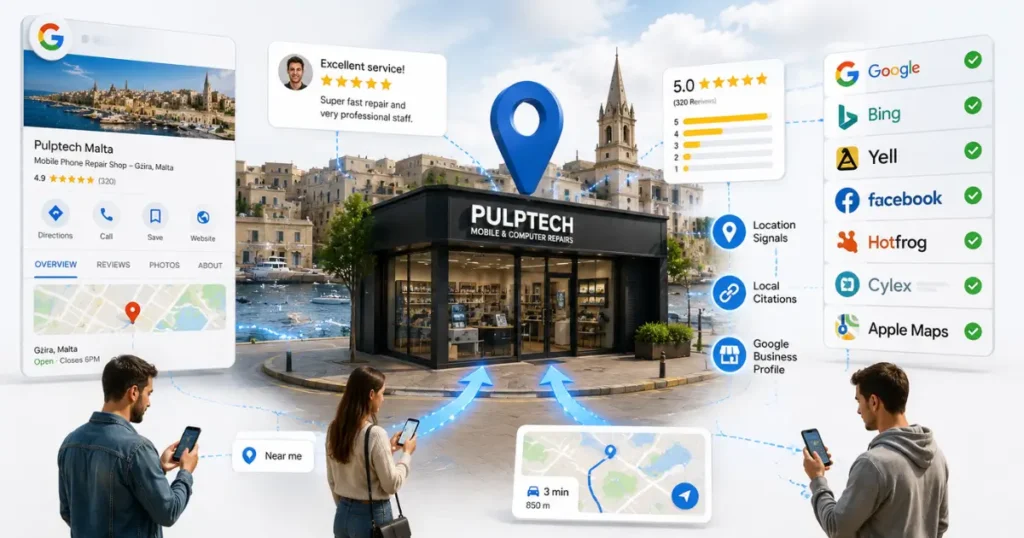
How Local SEO Works (Proximity, Prominence, Relevance)
Here’s a simple breakdown of how Google ranks local results:
- Proximity – how close your business address is to the person searching
- Prominence – how many reviews you have, how positive they are, and how often other sites mention you
- Relevance – how closely your Google Business Profile category and content match the search term
Get these three right, and you start showing up in Google’s Map Pack, that block of three businesses with a map that appears above regular search results.
Where Local SEO Shows Up
Local SEO results appear in Google Maps, the Local Pack (the map with three businesses), and “near me” searches. On mobile, this is often the very first thing people see.
What Is Traditional SEO?
Traditional SEO, sometimes called organic or national SEO, focuses on ranking your website for search terms no matter where the searcher is. A Malta-based ecommerce brand shipping across Europe needs this far more than local rankings.

How Traditional SEO Works
Traditional SEO leans on three core pillars:
- Content depth – does your page actually answer the question well
- Domain authority – how many quality sites link back to yours
- Technical health – is your site fast, secure, and easy for Google to crawl
None of these depend on your physical address. A well-written guide can rank in Malta, the UK, or Australia at the same time.
Where Traditional SEO Shows Up
You’ll find traditional SEO results in the regular organic listings, and increasingly in AI Overviews, the summary boxes Google now shows above search results.
Target Audience
Local SEO speaks to someone standing five minutes from your shop. Traditional SEO speaks to someone who might never set foot in Malta but still buys from your website.
Ranking Factors Compared
Local rankings lean heavily on real-world trust signals like reviews and citation consistency. Traditional rankings lean on content quality and backlinks. Both need a healthy, fast website underneath.
Search Intent Differences
Local searches usually carry navigational or transactional intent, someone wants to visit or call right now. Traditional searches often carry informational intent, someone researching before they decide anything.
People Also Ask: What’s the biggest difference between local and traditional SEO?
Local SEO targets nearby, ready-to-act customers using your Google Business Profile. Traditional SEO targets a wider audience through website content and backlinks, regardless of location.
Which One Does Your Malta Business Need?

Here’s the thing. Most Malta business owners think they have to pick one. You don’t.
If You Serve Customers in Gżira, Sliema, or One Locality
If people need to physically visit you, local SEO should be your priority. A dentist in Gżira doesn’t need to rank nationally. They need to rank for “dentist near me” within a five kilometre radius.
If You Sell Online or Nationally Across Malta
If you ship products, sell services online, or serve the whole island rather than one neighbourhood, you need traditional SEO working alongside your local presence.
Common Mistake: Treating Them as Either/Or
A lot of advice online frames this as a choice. That’s misleading. Even a hyper-local business benefits from a fast, well-structured website, since technical health also feeds local rankings. The two strategies overlap more than people assume.
People Also Ask: Can a small business skip traditional SEO completely? Not really. Even local-focused businesses need basic on-page SEO and a crawlable site, since these fundamentals support both ranking types and AI-generated answers.
How to Start With Local SEO in Malta
Getting started with local SEO Malta businesses can actually manage in-house, with a bit of consistency.
Set Up and Optimize Your Google Business Profile
Claim your listing, choose the right category, add real photos, and keep your hours accurate. This single step drives more local visibility than almost anything else.
Keep NAP Consistent Across Listings
NAP stands for Name, Address, Phone number. If your address on Facebook doesn’t match your website, Google gets confused about which one is correct, and your rankings suffer.
Build Local Citations and Reviews
Get listed on relevant Malta directories and ask happy customers for genuine reviews. Review velocity, meaning steady reviews over time, matters more than a sudden spike.
Add LocalBusiness Schema Markup
Adding LocalBusiness schema to your website helps Google and AI tools like Gemini and ChatGPT understand exactly who you are, where you’re based, and what you offer.
How to Build Traditional SEO Alongside It
On-Page Optimization and Content Depth
Write content that genuinely answers what people are searching for. Shallow, keyword-stuffed pages rarely hold up anymore.
Backlinks and Domain Authority
Earn links from credible Malta and international sites. Quality matters far more than quantity here.
Technical SEO Basics
A fast, mobile-friendly, secure website isn’t optional anymore. It’s the foundation both local and traditional rankings sit on.
Local SEO vs Traditional SEO Cost in Malta
Costs vary depending on how competitive your industry is and how much work your current site needs. Local SEO tends to cost less upfront since it centres on your Google Business Profile and citations, while traditional SEO often needs ongoing content and link building, which takes longer to show results.
People Also Ask: Is local SEO worth it for a small business? Yes. Since local searches often lead to a fast decision to call or visit, ranking in the Map Pack puts you in front of ready buyers, often for less than what paid ads cost.
FAQ
Local SEO targets nearby customers through your Google Business Profile. Traditional SEO targets a wider audience through website content and backlinks. It comes down to geography and intent.
Most small businesses need local SEO first. If you sell online or serve all of Malta, add traditional SEO too. They work best together, not as a substitute for one another.
Google ranks local results by proximity, prominence, and relevance, meaning how close you are, how trusted you appear, and how well your profile matches the search.
NAP means Name, Address, Phone number. Keeping it identical everywhere helps Google confirm your business is real, which directly affects your local ranking.
Most businesses see early Map Pack movement within four to eight weeks, with stronger results building over three to six months as reviews and citations grow.
Yes. It puts you in front of nearby customers who are ready to act, usually at a lower cost than running paid ads.